In this article
What to know
- SOUL tested a specific oral semaglutide regimen in high-risk type 2 diabetes.
- Primary cardiovascular events occurred in 12.0% versus 13.8%.
- The result does not establish equivalence across oral products or against injections.
An oral product can have outcome evidence of its own
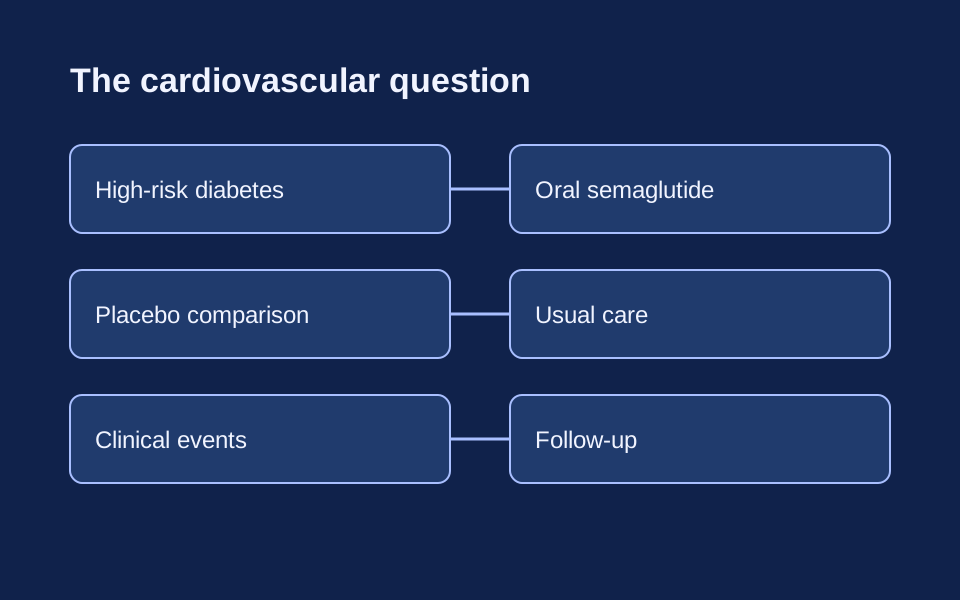
SOUL showed that a specific oral semaglutide regimen reduced major cardiovascular events compared with placebo in high-risk adults with type 2 diabetes. That is a more precise statement than saying that an oral medicine is just as good as any injection. The trial did not compare the two routes directly, and it did not test every product offered under the word oral. For a reader, the useful question is which preparation, population and outcome support the claim. Those details determine whether a result belongs in a conversation about diabetes and cardiovascular risk or is being stretched into a broader weight-loss advertisement.
Who SOUL enrolled
The trial randomized 9,650 adults aged at least 50 with type 2 diabetes and established atherosclerotic cardiovascular disease, chronic kidney disease, or both. Oral semaglutide, at a maximum study dose of 14 mg daily, was compared with placebo on top of standard care. Median follow-up was 49.5 months. [1] This describes the experiment rather than a treatment recommendation. The participants already had substantial risk and continued other care. The comparison therefore does not tell a healthy younger adult what benefit to expect, nor does it mean that other treatment for blood pressure, cholesterol or diabetes became unnecessary.
The main result concerns events, not just a blood test
The primary composite was cardiovascular death, nonfatal myocardial infarction or nonfatal stroke. It occurred in 579 of 4,825 participants assigned semaglutide, or 12.0%, versus 668 of 4,825 assigned placebo, or 13.8%. The hazard ratio was 0.86, with a 95% confidence interval of 0.77 to 0.96. [1] The crude event proportions differ by 1.8 percentage points during follow-up. That is distinct from the relative hazard comparison. Neither number should be presented as an individual guarantee, and a composite result should not be rewritten as though every component improved to the same degree in every patient.
Earlier safety evidence asked a narrower question
PIONEER 6 previously randomized 3,183 high-risk adults with type 2 diabetes to oral semaglutide or placebo. Over a median 15.9 months, the primary cardiovascular outcome occurred in 3.8% versus 4.8%; the hazard ratio was 0.79, with a confidence interval of 0.57 to 1.11. The study established noninferiority for cardiovascular safety rather than a statistically significant superiority result. [2] That distinction explains why the later trial matters. A directionally favorable number with uncertainty extending across no difference is not the same evidence as a trial that meets its superiority objective. The research story became stronger through a further experiment, not through more confident wording about the earlier one.
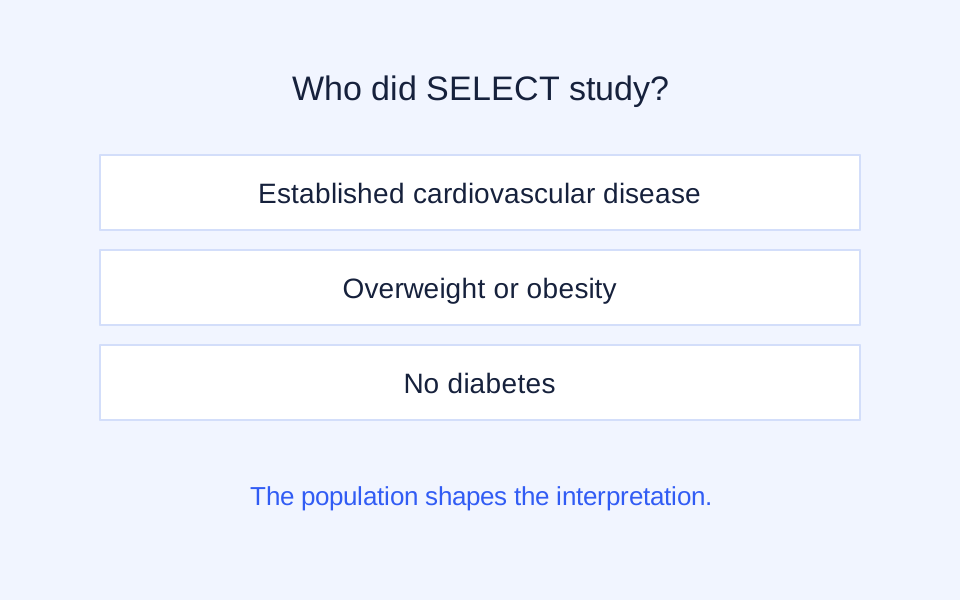
For a different population and injectable formulation, read our SELECT cardiovascular evidence.
Kidney claims need their own result
SOUL's confirmatory secondary outcomes, including its major kidney-disease composite, did not differ significantly between groups. [1] The cardiovascular result should therefore not be allowed to carry a separate kidney-benefit claim by association. That does not erase findings from other studies or settle every possible kidney question. It means this trial needs to be described on its own terms. When an article lists several potential benefits in one sentence, ask whether each was actually established in the cited experiment. A medicine can have a convincing result for one outcome while another outcome remains uncertain, even when both matter to the same patient.
Why the word oral is not enough
The January 2026 FDA label identifies Rybelsus and Ozempic tablets for adults with type 2 diabetes, including cardiovascular-risk reduction in adults at high risk, and states that the two tablet products are not interchangeable milligram for milligram. [3] A route of administration is a description, not proof that different preparations deliver equivalent exposure or have equivalent evidence. A reader considering treatment should ask the prescriber for the actual product name and formulation, rather than assume that a capsule, tablet, liquid or other marketed preparation inherits SOUL's outcome result. The trial also does not give a head-to-head estimate against an injectable regimen. That comparison would require a different design. Keeping the wording specific helps avoid an easy commercial shortcut: borrowing the appeal of a large cardiovascular study to support an offer that was never part of it.
For the formulation distinction, use our oral versus injectable guide.
Safety belongs beside the benefit
In SOUL, serious adverse events occurred in 47.9% of the semaglutide group and 50.3% of placebo, while reported gastrointestinal disorders occurred in 5.0% and 4.4%. Novo Nordisk funded the trial. [1] These figures belong to an older, high-risk population followed for several years; they are not a short list of what an individual will experience after starting treatment. A personal assessment still needs the relevant medical history and other medicines. The practical question is how symptoms will be assessed and who will make changes if treatment is difficult to continue. A favorable group-level safety comparison does not remove that need for follow-up.
What a provider comparison should add
The trial cannot tell a buyer which clinic has the best response time, which subscription offers good value or whether an insurer will authorize a prescription. Those are separate questions with their own evidence. A useful provider comparison should state whether the service supports diabetes care, branded access, insurance navigation or a cash-pay compounded pathway. A reader should not have to infer the product from an attractive price beside a research claim. Ask for the complete continuing cost and the intended clinical relationship, then discuss whether the exact prescription has evidence that matches the reason it is being considered.
For a service model built around continuing care, compare our Form Health review.
Take a precise result into the consultation
SOUL supplies meaningful evidence about cardiovascular events in its defined high-risk diabetes population. The most useful next step is to ask how that evidence fits your own cardiovascular and kidney history and the specific product being proposed. There is no need to turn the trial into a route-of-administration contest or a self-directed change in treatment. Keep the scientific claim narrow enough to remain true, and the service comparison concrete enough to be useful. An informed purchase begins when the product, clinical purpose and continuing care are clear on the same page, rather than scattered across a medication advertisement and a separate payment form.
Sources
Research describes groups and specific study conditions. Your medical history, symptoms and treatment decisions require advice from your own qualified clinician.