In this article
What to know
- LEADER observed 141 versus 88 biliary events over multi-year follow-up.
- Its hazard ratio is not an annual or personal risk estimate.
- A short emptying study cannot settle the rate of clinical disease.
A real safety question needs the denominator
Gallbladder and biliary events have been reported in GLP-1 trials, and a liraglutide analysis found more events than placebo. [1] That warrants a clear discussion of risk. It does not mean that most people develop gallbladder disease or that every abdominal symptom has the same cause. The useful reading keeps the medicine, participant group, event definition and follow-up together. A relative increase without those details is incomplete information for a treatment decision.
It is also important to separate an event analysis from a mechanism experiment. A study can show that events occurred more often without fully establishing why. Another can measure gallbladder movement without being large enough to determine the rate of clinical disease. Both kinds of evidence matter, but they should not be made to answer each other's questions.
What LEADER actually observed
LEADER randomized 9,340 adults with type 2 diabetes at high cardiovascular risk to daily liraglutide up to 1.8 mg or placebo alongside standard care. Its post hoc biliary analysis covered treatment lasting 3.5 to 5 years. Gallbladder or biliary disease occurred in 141 of 4,668 liraglutide participants and 88 of 4,672 placebo participants; the hazard ratio was 1.60, with a 95% confidence interval of 1.23 to 2.09. [1]
The crude proportions are approximately 3.0% and 1.9%, a difference of about 1.1 percentage points over that trial's follow-up. Those proportions are calculated from the published counts. They are not annual rates, and the hazard ratio is a time-to-event comparison rather than simply the ratio of those percentages. The finding belongs to liraglutide in that population, not an individualized forecast for every GLP-1 prescription.
An obesity trial adds another setting
SCALE Obesity and Prediabetes studied liraglutide 3.0 mg in 3,731 adults without type 2 diabetes, alongside lifestyle intervention, over 56 weeks. Its report identified gallbladder-related events more often with liraglutide than placebo. [2] That gives the safety question relevance beyond a cardiovascular-outcomes population with established diabetes. The 3.0 mg obesity-trial regimen differs from LEADER’s regimen; these are descriptions of research protocols, not personal dosing instructions.
The two trials still should not be merged into a single universal rate. Their participants, treatment settings and duration differed. A prescribing conversation should use the current information for the actual medication and formulation, with the person's history taken into account. A comparison table that transfers the exact LEADER percentage to every service selling a GLP-1 product would be more precise-looking than the evidence allows.
A small experiment tested emptying, not disease prevention
A separate 12-week randomized study assigned 52 adults with overweight or obesity without diabetes to liraglutide or placebo. Researchers measured gallbladder emptying after a test meal. The maximum ejection fraction did not differ significantly between groups, while the time to reach maximum emptying appeared longer with liraglutide. [3]
That is a useful distinction. The study does not support a simple claim that the gallbladder stopped working, nor does its nonsignificant primary measure rule out clinical events observed in larger trials. A short physiological experiment and a multi-year event analysis operate at different scales. The mechanism remains a question to investigate rather than a reason to dismiss either set of findings.
Why weight loss does not settle the explanation
It is tempting to attribute every biliary event to either the medicine itself or the amount of weight lost. The LEADER investigators explored the relationship with weight change, but an analysis of post-randomization changes cannot recreate a trial that separately assigns those pathways. [1] More than one explanation can remain plausible without making the observed group difference disappear.
For a reader, the practical consequence is to avoid treating one mechanism as a personal risk calculator. The amount someone expects to lose is not enough to determine whether they will develop a gallbladder problem. Equally, a clinician should not dismiss a new symptom merely because weight change is an expected part of care. The explanation and the response to a symptom are separate decisions.
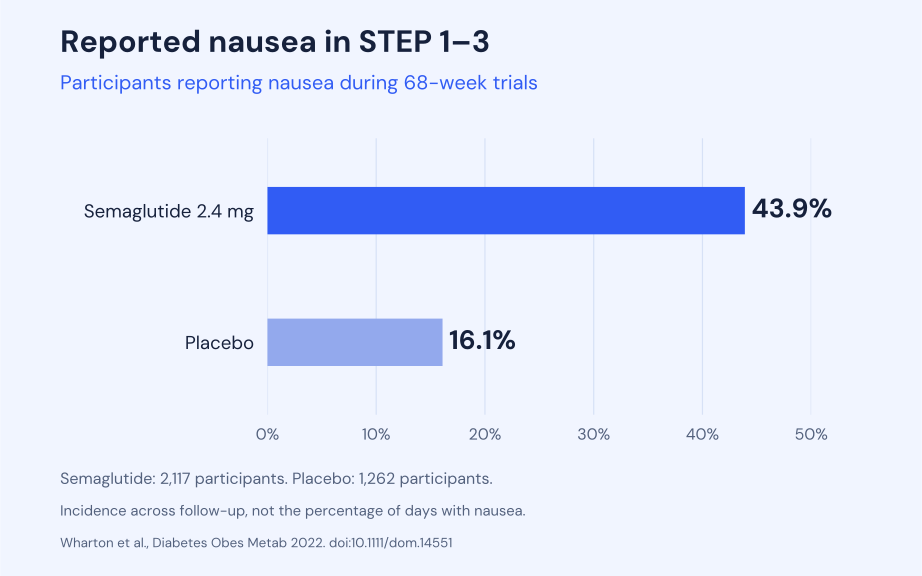
Our guide to Semaglutide nausea evidence addresses common gastrointestinal symptoms; that evidence should not be used to dismiss a different biliary concern.
Use the finding to ask about follow-up
This evidence supports discussing relevant history and a plan for new symptoms with the prescriber. It does not provide a self-diagnosis checklist or justify changing medication without that discussion. Ask which warning symptoms the chosen product's current instructions identify, how quickly to seek assessment and whom to contact if the usual care team is unavailable.
That conversation is especially important when care is arranged through an online platform. A message portal can be helpful for routine questions, but the reader should understand when local or urgent evaluation is necessary. A promise of fast shipment or unlimited messaging does not answer that clinical access question. The responsibility should be clear before it is needed.
Compare a service on the care it can supply
A provider review can explain price, prescribing arrangements and follow-up access. It cannot use the absence of an advertised adverse-event statistic to prove that one clinic is safer than another. Drug-trial safety findings also do not measure every platform's performance. These are different kinds of comparison, and each deserves an honest basis.
The reasonable conclusion is specific: biliary risk is a documented consideration, the absolute number of events was much smaller than the number without events, and the exact relevance depends on the treatment and person. Keep that balance when discussing options. Neither an alarming relative number nor a reassuring sales page should replace a clear plan for evaluating symptoms during care.
The PlushCare review explains a visit-based service to consider when comparing clinical access and follow-up costs.
Sources
Research describes groups and specific study conditions. Your medical history, symptoms and treatment decisions require advice from your own qualified clinician.