In this article
What to know
- GRADE compared four add-on diabetes medicines over about five years. Liraglutide and glargine maintained the glucose target longer, with important limits.
- Population, comparison and follow-up determine what the finding can establish.
- A study average is not an individualized outcome prediction.
A longer comparison of common diabetes strategies
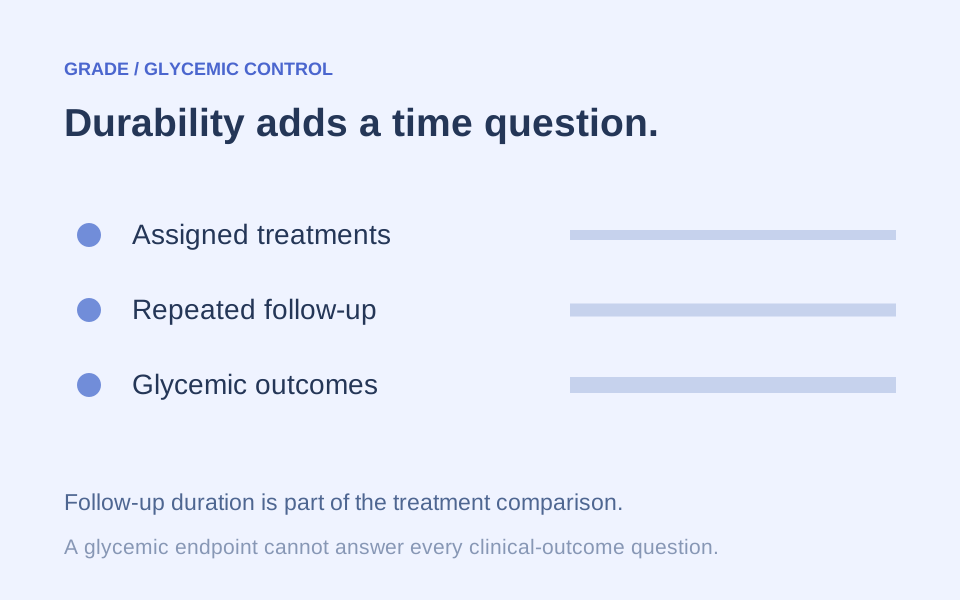
GRADE compared four medicines added to metformin in people with type 2 diabetes. Its main question was how well each strategy maintained a glycemic target over years, rather than how much a laboratory measure changed over a few months. Liraglutide and insulin glargine performed similarly on that durability question and better than glimepiride or sitagliptin. That is valuable comparative evidence, but it is not a claim that liraglutide permanently prevents progression or is the right option for every patient. The trial also predates several current treatment comparisons, so its four-way result should not be expanded into a ranking of all available diabetes medicines.[1]
For the related decision, read the connected evidence.
Who was studied and what counted as the event
The randomized study included 5,047 participants receiving metformin, with type 2 diabetes of less than ten years' duration and baseline HbA1c in the trial's eligible range. Follow-up averaged about five years. The primary metabolic event was a quarterly HbA1c measurement of at least 7.0% that was subsequently confirmed. That threshold was a study endpoint, not a universal personal target supplied by this article. Confirming the result helps distinguish a persistent crossing from a single measurement. A clinician still needs to individualize treatment goals according to the person's medical situation rather than applying a research threshold without context.[1]
Rates are not cumulative percentages
The report gives primary-event rates of 26.1 per 100 participant-years for liraglutide, 26.5 for glargine, 30.4 for glimepiride and 38.1 for sitagliptin. These are rates that incorporate follow-up time. They should not be presented as the percentage of participants experiencing an event over five years. Nor should a reader multiply a rate mechanically by the number of years to create a personal risk estimate. Keeping the units visible prevents a substantial misreading of the study. The important comparative finding is the more durable maintenance of the specified glycemic threshold with liraglutide and glargine under the trial's conditions.[1]
Durability does not mean the disease stopped changing
A strategy can delay crossing a glucose threshold without establishing permanent disease modification. Some participants in every group still met the trial's failure criterion, and clinical treatment may need adjustment over time. The word durability refers here to maintaining a measured target during follow-up. It does not mean a finite course has cured diabetes or that monitoring can end. This distinction is useful when a consumer encounters language about preserving control. Ask whether a claim concerns time to a laboratory threshold, reduced medication requirements, a clinical complication or an off-treatment response. Those outcomes cannot be used interchangeably.
For the related decision, read our support-model comparison.
The tradeoffs were not identical across groups
The investigators reported more gastrointestinal adverse effects and greater weight loss with liraglutide, while severe hypoglycemia differed across the comparator strategies. A treatment that performs well on the primary glycemic endpoint can therefore have different practical advantages and burdens from another option with a similar primary result. Injection preferences, symptoms and background medicines may matter to an individual in ways the average ranking does not summarize. The trial's purpose was comparative effectiveness, not to reduce the entire care decision to one number. Discuss the benefits and adverse effects together, particularly when an existing regimen already poses a hypoglycemia concern.[1]
The cardiovascular paper asked separate questions
A companion GRADE report examined prespecified microvascular and cardiovascular outcomes. These were important secondary outcomes, but the trial was not primarily designed as a dedicated event-driven cardiovascular safety or superiority program. Its findings should not be used to infer that every treatment has identical effects on all complications, or to substitute a glucose-target result for a clinical-event result. If prevention of cardiovascular or kidney events is central to a patient's care, the appropriate discussion includes dedicated evidence and current indications. The presence of a secondary outcomes paper does not make the primary glycemic endpoint a direct measure of those events.[2]
The product and dose context matter
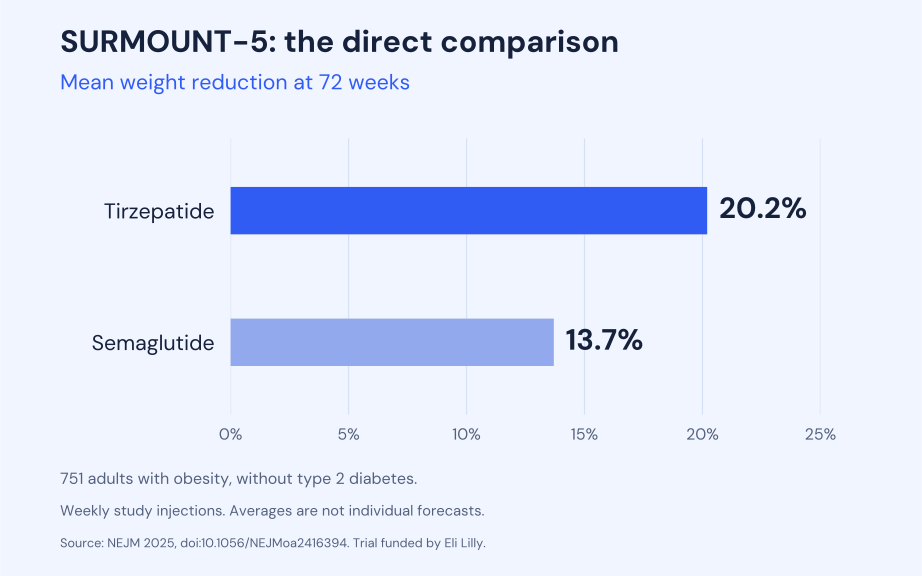
GRADE's liraglutide strategy belongs to diabetes treatment, not the liraglutide obesity-dose program. Current Victoza labeling specifies the diabetes product, its indications and its safety information. A person should not assume that a weight-management preparation at another dose has been tested in the same comparison. The trial also did not include semaglutide, tirzepatide or an SGLT2 inhibitor as randomized groups. An apparent preference within GRADE therefore does not establish superiority over treatments it never evaluated. A useful appointment question is which contemporary evidence addresses the actual options now available through the patient's coverage.[1] [3]
For the related decision, read our 9Amhealth review.
Longer follow-up is valuable without settling every setting
A multi-year randomized comparison addresses an important gap left by shorter glucose-lowering trials. It also remains a structured research environment with its own eligibility requirements, follow-up and treatment protocol. Real-world access interruptions, changing benefits and differences in clinical support can affect how well a strategy is sustained. Those possibilities do not invalidate the randomized result. They help explain why choosing an effective medicine and arranging continuing care are connected but separate tasks. A service should be evaluated for monitoring, medication review and continuity rather than assuming a trial's durability average automatically transfers to any prescribing platform.
What the patient can ask the clinician
Bring the current HbA1c pattern, medication list, adverse effects and relevant health history to the discussion. Ask what target is appropriate, which evidence supports the proposed medicine for the person's priorities, and how control will be reviewed if the first strategy becomes insufficient. These are applications of the trial's comparative question, not instructions to switch treatment. If a headline uses the GRADE rates, ask for their time units and endpoint definition. Understanding what the number measures is more useful than choosing the smallest one without knowing whether it describes a laboratory threshold, a side effect or a clinical event.
The conclusion worth keeping
GRADE shows that liraglutide and glargine maintained the specified glycemic target more durably than glimepiride or sitagliptin when added to metformin in the studied population. It also shows why a longer comparison still needs careful interpretation. Event rates are not cumulative percentages, a glucose endpoint is not every diabetes complication, and a four-treatment trial cannot rank medicines it did not include. Use the findings to support a focused clinical conversation about goals, tolerability and continuing care. The result is useful precisely because it answers a defined question rather than promising a permanent solution for every person with diabetes.[1] [2] [3]
Sources
Research describes groups and specific study conditions. Your medical history, symptoms and treatment decisions require advice from your own qualified clinician.