In this article
What to know
- PIONEER 4 compared an oral semaglutide formulation with injected liraglutide in diabetes. Noninferiority, dose and analysis define its meaning.
- Population, comparison and follow-up determine what the finding can establish.
- A study average is not an individualized outcome prediction.
An oral route tested against an active injection
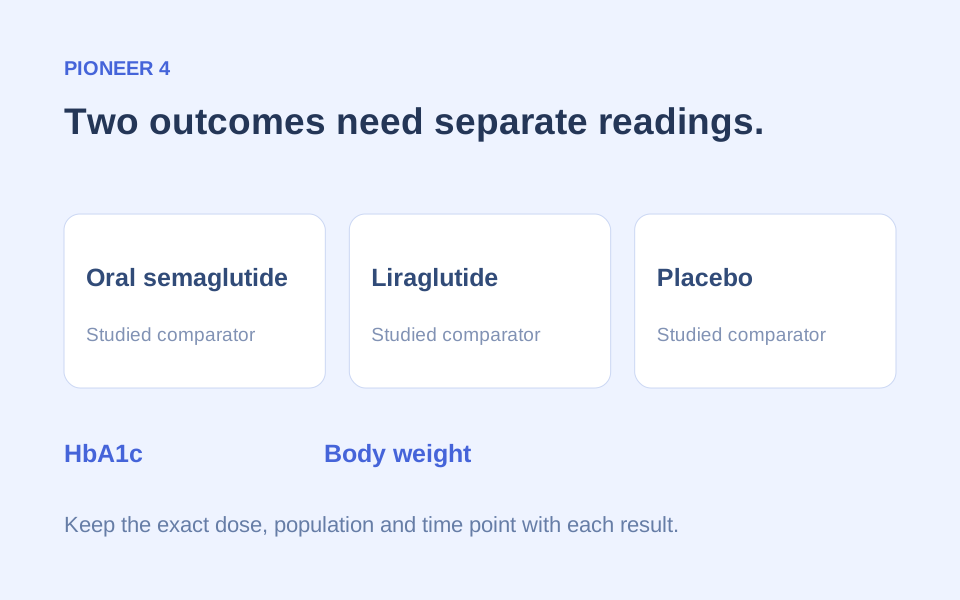
PIONEER 4 asked whether oral semaglutide could lower HbA1c at least as effectively as injected liraglutide in a defined type 2 diabetes population, while also comparing both with placebo. The primary analysis supported noninferiority to liraglutide and superiority to placebo for glucose lowering. That is more precise than saying a pill beat an injection. Noninferiority is a specific statistical claim, and a result can differ when the analysis asks what happens with continued treatment rather than assignment to a strategy. The useful story is about a viable oral treatment pathway with identifiable limits, not a universal ranking of administration routes.[1]
For the related decision, read the connected evidence.
Who and what were studied
Investigators randomized 711 adults receiving metformin, with or without an SGLT2 inhibitor. The assigned treatments were daily oral semaglutide escalated to 14 mg, daily injected liraglutide escalated to 1.8 mg, or placebo. The trial lasted 52 weeks, with the primary comparison at 26 weeks. It used double blinding and double dummy treatment so differences in route could be compared while preserving masking. The trial did not compare weekly obesity-dose semaglutide with liraglutide 3 mg. Naming the doses is essential because the same ingredient can appear in different products, indications and evidence programs.[1]
Noninferiority is a bounded comparison
The trial's primary treatment-policy analysis found oral semaglutide noninferior to liraglutide for HbA1c reduction using a prespecified margin. That means the analysis ruled out a disadvantage beyond that margin under the study's assumptions. It does not establish that every participant responded equally or that the treatments are identical. The mean HbA1c reductions were about 1.2 and 1.1 percentage points for oral semaglutide and liraglutide respectively, compared with 0.2 for placebo at week 26. Those changes concern a glucose measure. They should not be rephrased as the same percentage change in diabetes complications or life expectancy.[1]
The other estimand gave a different emphasis
Under the trial-product estimand, which addressed continued study treatment without rescue medication, the glucose comparison favored oral semaglutide more clearly. That does not make the primary treatment-policy result obsolete. The analyses answer different questions and use assumptions about treatment continuation and missing measurements. A reader should not take the stronger on-treatment result and describe it as the unqualified result for everyone starting the medicine. The practical lesson is to ask which analysis a headline quotes. A treatment can be effective while discontinuation, rescue treatment and administration demands still influence the outcome of the assigned strategy.[1]
For the related decision, read our support-model comparison.
Weight was a separate endpoint
At 26 weeks, the trial found greater average weight reduction with oral semaglutide than with liraglutide in the studied diabetes comparison. That result is relevant without turning PIONEER 4 into a trial of obesity treatment or a promise about any oral preparation. Weight was a separate endpoint from the primary glycemic comparison, and the tested liraglutide dose was 1.8 mg. It would be incorrect to substitute the 3 mg obesity regimen and claim that the trial directly compared those alternatives. A useful treatment discussion keeps the actual endpoint, dose and population attached to the result rather than letting a familiar brand name fill in missing details.[1]
Current liraglutide labeling adds clinical context
Victoza's current US prescribing information describes its diabetes and cardiovascular indications, dose forms, contraindications and precautions. Its pen delivers doses up to the 1.8 mg level used as the active comparator here. That helps identify the clinical pathway behind the study, while the cardiovascular indication comes from separate evidence rather than this glucose comparison. The label also makes clear that relevant history and other medications affect treatment suitability. A small difference in average HbA1c does not override contraindications, tolerability or the need to coordinate care. The correct comparison is a real prescribing decision, not a contest between an oral and injected format.[2]
The oral product identity has evolved
The FDA's 2026 oral semaglutide label covers Rybelsus and Ozempic tablets with distinct strengths and states that they are not substitutable milligram for milligram. PIONEER 4's 14 mg figure belongs to the formulation studied in that protocol. It cannot be used as a direct conversion instruction for another tablet, much less an unapproved capsule or sublingual product. The practical question for a patient is which exact product is being prescribed and how it should be administered under its current instructions. An oral route can be convenient without all oral preparations becoming equivalent evidence or equivalent doses.[3]
For the related decision, read our Form Health review.
Convenience is more than avoiding a needle
An injection and a tablet create different routines. Current oral semaglutide instructions include an empty-stomach process and a waiting interval before eating, drinking or other oral medication. That may fit one person's morning easily and complicate another person's schedule. Liraglutide has its own product instructions and daily injection routine. PIONEER 4's double-dummy design was designed for scientific comparison, not to reproduce every real-world convenience difference. A buyer should therefore discuss the practical routine separately from the efficacy result. Choosing a route requires assessing how the actual instructions fit ordinary days, rather than assuming tablets always mean less effort.[2] [3]
Tolerability and rare harms need separate attention
Adverse events were common in both active-treatment groups, and gastrointestinal symptoms were part of the treatment experience. The trial does not establish that an oral GLP-1 avoids the class's tolerability issues. Nor is a study of this size and duration sufficient to settle every rare or delayed risk. Current labeling includes warnings and contraindications that should be reviewed for the exact product. A useful care service should explain how symptoms are assessed and how the plan changes if continuation is unsuitable. The drug trial cannot verify a clinic's responsiveness, billing practices or quality of individual follow-up.[1] [2] [3]
The conclusion that belongs in the headline
PIONEER 4 supported the studied oral semaglutide formulation as a glycemic alternative to liraglutide 1.8 mg within its diabetes population, with a favorable weight comparison and an analysis-dependent glucose interpretation. Novo Nordisk funded the trial. It did not prove that all pills outperform injections, compare obesity-dose regimens or validate unrelated compounded oral products. Bring the formulation, goal, medical history and daily routine to an appointment. Then use the trial to ask a specific question about an appropriate oral option. Its strongest contribution is making that question answerable without pretending that route alone decides the treatment.[1] [2] [3]
Sources
Research describes groups and specific study conditions. Your medical history, symptoms and treatment decisions require advice from your own qualified clinician.