In this article
What to know
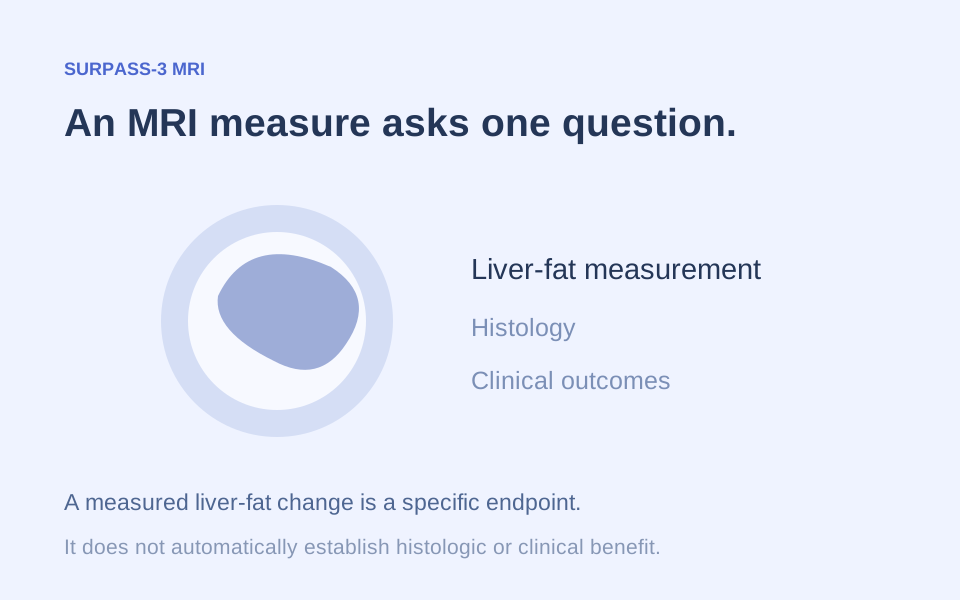
- SURPASS-3 MRI found greater liver-fat reduction with tirzepatide than degludec. MRI fat fraction is distinct from biopsy-proven MASH or fibrosis outcomes.
- Population, comparison and follow-up determine what the finding can establish.
- A study average is not an individualized outcome prediction.
The outcome was an imaging measure of liver fat
SURPASS-3 MRI compared tirzepatide with insulin degludec in a selected group of adults with type 2 diabetes. Its liver-fat result favored tirzepatide, but the endpoint needs to stay attached to the claim. Investigators measured liver fat using MRI proton-density fat fraction, not a biopsy endpoint showing resolution of steatohepatitis or improvement in fibrosis. That distinction matters when metabolic research appears in a weight-care advertisement. Lower fat on an imaging measure can be informative without establishing every possible liver benefit. This study should be read as evidence about the measured fat outcome in its defined population, not as a promise that a particular treatment reverses all liver disease.[1]
For the related decision, read the connected evidence.
An MRI substudy is a selected part of the parent trial
The MRI population included 296 participants from SURPASS-3. In addition to the parent trial's diabetes criteria, substudy participation required features including a fatty liver index of at least 60. The parent study compared weekly tirzepatide with daily titrated degludec in insulin-naive adults receiving metformin, with or without an SGLT2 inhibitor. The substudy therefore does not represent an unrelated trial of people selected only because of liver disease. Nor does every parent-trial participant contribute an MRI result. Understanding who entered the imaging sample helps assess how far the findings can be generalized beyond the study.[1] [2]
The primary contrast pooled two tirzepatide groups
The prespecified primary liver-fat comparison used pooled data from the tirzepatide 10 mg and 15 mg groups versus degludec at week 52. Overall mean baseline liver fat was approximately 15.71%. The absolute change was about −8.09 percentage points in the pooled tirzepatide groups and −3.38 points with degludec, an estimated contrast of −4.71 points. Those are changes in the liver-fat fraction measure, not kilograms of fat removed from the body or percentage reductions in liver failure. Pooling the groups also means that primary figure should not be described as the precise result of every individual dose.[1]
Absolute and relative reductions are different quantities
A liver-fat fraction can be expressed as a percentage, but a change between two such measurements is commonly reported in percentage points. A relative percentage reduction uses the starting value as its denominator. Those expressions can sound similar while producing very different numbers. A consumer should ask which is being quoted before comparing two headlines. The study's absolute reduction should not be relabeled as an equivalent relative reduction, and a relative reduction should not be mistaken for the percentage of participants whose disease resolved. The endpoint, calculation and denominator need to remain visible together whenever the result is summarized.
For the related decision, read our support-model comparison.
Less liver fat is not a biopsy verdict
MRI-PDFF quantifies fat; it does not directly score all the cellular injury and fibrosis features used in a histological liver-disease trial. This limitation does not make the measurement meaningless. It defines what the experiment established. A claim about biopsy-proven MASH resolution or fibrosis improvement needs evidence from a study that actually measures those outcomes. A clinician may use imaging alongside other clinical information, but an article cannot replace that assessment with one fat number. The distinction is particularly important for someone with suspected advanced disease, whose care priorities extend beyond whether a metabolic treatment changes a surrogate measure.[1]
The active comparator shapes the interpretation
Degludec was an active glucose-lowering treatment, with its dose titrated under the parent protocol. The trial did not compare tirzepatide against every other liver-directed or metabolic treatment. It also cannot isolate the entire liver response from accompanying changes in weight and metabolism merely because treatment was randomized. The liver-fat paper examined correlations with changes in other fat compartments and body weight, but correlation is not proof that one mechanism explains the full effect. The stronger claim is the randomized contrast between these strategies under the protocol. The detailed biological pathway remains a separate research question.[1] [2]
A later fat-distribution analysis is complementary
A subsequent analysis of the SURPASS-3 MRI cohort explored body-fat distribution using matched virtual control groups drawn from UK Biobank imaging data. That work can provide a useful reference for how fat compartments relate to expected patterns. It is not a new randomized comparison against those virtual controls, and it is not independent replication in a fresh treatment cohort. The distinction matters because a sophisticated matching method does not turn an observational reference population into another assigned trial arm. Read the later analysis for its specific distribution question while keeping the original randomized degludec comparison separate.[3]
For the related decision, read our 9Amhealth review.
Current product labeling addresses a different practical layer
Mounjaro's current prescribing information identifies the approved tirzepatide product, indications and safety information. It also contains important contraindications and warnings that an imaging result does not override. The MRI study should not be used to assume equivalent outcomes for every compounded formulation or to choose a dose without medical assessment. Current indications must be checked independently rather than inferred from a historical substudy. For a patient, the relevant conversation includes the exact diagnosis, the purpose of treatment and the measures that will be used for follow-up. A promising metabolic endpoint is one part of that conversation, not the entire treatment decision.[4]
How to read a liver-fat marketing claim
Look for the measurement method, study population, comparator, follow-up and whether the cited result is absolute or relative. Ask whether the commercial service supplies the same product and whether the claim has shifted from fat reduction to disease resolution without additional evidence. These questions are useful even when the numerical quotation itself is accurate. A program might reproduce a trial number correctly while implying a broader clinical outcome than was tested. For someone with liver concerns, choosing an identifiable care team that can evaluate the condition is more important than selecting the most impressive isolated reduction on a product page.
The conclusion worth keeping
SURPASS-3 MRI supports a greater average reduction in MRI-measured liver fat with pooled tirzepatide 10 mg and 15 mg than with titrated degludec over 52 weeks in this selected diabetes population. It does not by itself establish biopsy-proven MASH resolution, fibrosis reversal or prevention of liver complications. The later fat-distribution work adds context rather than a new randomized replication. Keep those boundaries visible when considering a commercial claim or preparing for a clinical discussion. The evidence is useful because it identifies a measurable metabolic effect without requiring every possible liver benefit to be assumed.[1] [2] [3] [4]
Sources
- Gastaldelli et al. SURPASS-3 MRI randomized substudy (2022) (opens in a new tab)
- Ludvik et al. SURPASS-3 parent randomized trial (2021) (opens in a new tab)
- Cariou et al. SURPASS-3 MRI body-fat distribution analysis (2024) (opens in a new tab)
- Mounjaro current prescribing information revised August 2026 (opens in a new tab)
Research describes groups and specific study conditions. Your medical history, symptoms and treatment decisions require advice from your own qualified clinician.