In this article
What to know
- SURMOUNT-OSA tested adults with obesity and diagnosed moderate-to-severe obstructive sleep apnea.
- An AHI reduction does not mean every participant no longer needed treatment.
- Changes to PAP require clinical reassessment.
An improvement in breathing, measured directly
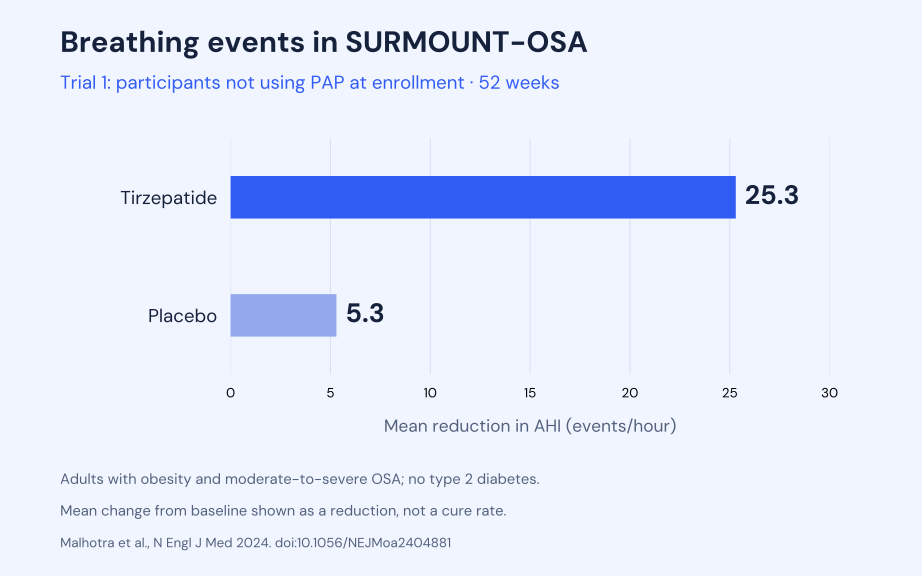
Tirzepatide reduced sleep-apnea severity in adults with obesity and moderate-to-severe obstructive sleep apnea in SURMOUNT-OSA. The trial measured nighttime breathing events rather than relying only on weight change or a report of quieter snoring. That distinction matters: a medicine can have an effect on a sleep disorder without making every person free of that disorder. [1]
The useful next question is whether your diagnosis and treatment setting resemble those studied. Someone with unexplained tiredness has a different starting point from someone whose sleep study has already established obstructive sleep apnea. A prescription consultation cannot replace that missing diagnosis.
Two studies answered two related questions
The program comprised two randomized, double-blind, placebo-controlled trials lasting 52 weeks. Across them, 469 adults had obesity and moderate-to-severe obstructive sleep apnea without type 2 diabetes. One trial enrolled people not using positive airway pressure, or PAP. The other enrolled people already receiving PAP. Participants received maximum tolerated tirzepatide 10 or 15 mg weekly or placebo. Eli Lilly funded the research. [1] [2]
Keeping those groups separate is essential. Combining their descriptions into a single claim that medication replaced a breathing device would lose the trial design. People already using a device were deliberately represented in their own study.
For another part of this decision, see Semaglutide vs tirzepatide: what the direct trial answers.
What the breathing-event numbers mean
The apnea–hypopnea index, or AHI, counts stopped or shallow breathing events per hour of sleep. In the trial without PAP at enrollment, mean AHI fell by 25.3 events per hour with tirzepatide and 5.3 with placebo. The estimated between-group difference was 20.0 fewer events per hour at week 52. [1]
This is a difference in events, not a percentage of participants cured. A large reduction can still leave clinically important apnea, depending on the starting level and individual response. Nor is an average result an instruction to judge success after a particular number of injections. Follow-up testing and symptoms answer different parts of that question.
Approval has a defined population
In December 2024, FDA approved Zepbound for moderate-to-severe obstructive sleep apnea in adults with obesity, together with a reduced-calorie diet and increased physical activity. The approval belongs to that named product and indication. It does not establish a class-wide indication for every GLP-1 medicine or establish the effectiveness of a compounded preparation. [2]
A useful consultation therefore names both the sleep diagnosis and the proposed medication. “GLP-1 access” on a membership page is too broad to answer whether a service can manage this particular condition, coordinate existing care or provide the required follow-up. Those are questions about care scope as well as prescribing.
A better night does not authorize stopping PAP
NHLBI describes PAP as the most common treatment for sleep apnea and also discusses medicines, oral devices and other options. Which treatment belongs in an individual plan depends on clinical assessment. [3] Feeling more rested or hearing less snoring is useful information to report, but it cannot show how many breathing interruptions remain during sleep.
If you already use PAP, discuss medication alongside that existing plan. Establish who will interpret repeat testing and who will decide whether device settings or treatment should change. Avoid allowing two separate providers to assume the other is handling reassessment. The practical goal is a coordinated plan with a clear owner.
Separate breathing benefit from tolerability
A favorable sleep outcome does not remove the medication’s risks or the need to assess suitability. The FDA approval announcement describes gastrointestinal side effects and important contraindications, including a personal or family history of medullary thyroid carcinoma or MEN 2. [2] Read the current prescribing information with the clinician, especially when other medicines or medical conditions are involved.
The service should also explain how concerns are handled between visits. A refill reminder and an appointment for a new symptom do different jobs. Ask which channel reaches the clinical team, what happens outside normal hours and whether a sleep specialist remains involved. Those details matter even when the medicine itself is well studied.
Compare a care arrangement that can follow through
Before choosing an online service, write down three separate costs: prescribing care, the exact medication and sleep-related assessment. A medicine discount may leave the other two untouched. Insurance support can help with an application while leaving authorization uncertain. The relevant comparison is the complete plan you can continue, including the clinicians already treating your sleep apnea.
Our Ro versus Form Health comparison helps distinguish access support from an ongoing care-team model. LillyDirect is a separate fulfillment pathway when prescribing care is already arranged. Use those comparisons to identify the missing service, then ask explicitly whether sleep-apnea care falls within its scope. Neither a low fee nor a strong trial result answers that operational question.
When weighing the care options, use Compare Ro and Form Health.
Sources
Research describes groups and specific study conditions. Your medical history, symptoms and treatment decisions require advice from your own qualified clinician.