In this article
What to know
- The principal study tested daily injected liraglutide with lifestyle counseling.
- Maintenance participants had already responded to a diet run-in.
- Longer follow-up is limited by substantial withdrawal.
Daily treatment has its own evidence
Liraglutide has randomized weight-management evidence in its own right; it should not be judged only by whether a newer weekly medicine produces a larger headline average. The SCALE studies examined starting treatment, maintaining diet-induced weight loss and longer follow-up in people with prediabetes. [1] [2] [3] Those are related decisions with different starting points. A reader comparing offers should first identify which question matches their situation. Someone considering a first prescription is not in the same position as a participant who already lost weight during a supervised run-in. The distinction controls what the published numbers can reasonably mean for a consultation.
The main trial tested a defined daily regimen
SCALE Obesity and Prediabetes enrolled 3,731 adults without type 2 diabetes, with obesity or overweight plus specified related conditions. Participants received daily subcutaneous liraglutide 3.0 mg or placebo for 56 weeks, and both groups received lifestyle counseling. Mean weight reduction was 8.4 kg versus 2.8 kg, an estimated difference of 5.6 kg. At least 5% weight loss occurred in 63.2% versus 27.1%. [1] These are group results under the study’s analysis, not a forecast for every individual. They also concern the studied injection and schedule, rather than any product that happens to use the same ingredient name.
A useful effect does not remove the treatment burden
Nausea and diarrhea were frequent adverse effects in the main trial, generally mild or moderate; serious adverse events were reported in 6.2% with liraglutide and 5.0% with placebo. [1] The practical interpretation is not that a successful average makes tolerability secondary. A daily regimen has to remain workable for the person using it, with a clinician responsible for assessment and follow-up. Someone comparing services should be able to discuss what happens if symptoms interfere with eating, activity or treatment continuation. The study dose is a description of the experiment, not an instruction to start or change a prescription independently.
Maintenance began after an initial diet response
SCALE Maintenance randomized 422 adults who had already lost at least 5% during a low-calorie-diet run-in. Over the following 56 weeks, additional mean weight change was −6.2% with liraglutide 3.0 mg daily and −0.2% with placebo; both groups continued diet-and-exercise counseling. More liraglutide participants maintained the initial loss. [2] The selection matters: this was not a trial of every person starting from their original weight. It supports an additional maintenance role in that context. It does not show that everyone must complete a comparable diet first, or that a commercial program reproduces the same response by using the word maintenance.
For the separate question of what happens after treatment ends, read Weight regain after stopping GLP-1 treatment.
Three-year follow-up answers a narrower risk question
The extension in participants with prediabetes assigned 2,254 people to daily liraglutide or placebo with lifestyle measures. At 160 weeks, mean weight changes were −6.1% and −1.9%; diabetes was diagnosed during treatment in 2% and 6% of the relevant analysis groups. Only half completed follow-up through week 160, and withdrawn participants were not followed after discontinuation. [3] That attrition limits how confidently the result can describe everyone who began. The diabetes finding is valuable, but it should not be retold as a guarantee that treatment permanently prevents diabetes after medication stops.
A threshold and an average tell different stories
An average weight change and the proportion crossing a threshold answer different questions. The average summarizes the whole distribution, while a five-percent response threshold counts people on either side of one boundary. Neither statistic identifies the result a particular new patient will obtain. In a consultation, it can be more useful to discuss what would count as meaningful benefit for the individual and when to reassess than to choose one published number as a target. That discussion can include tolerability, daily functioning and the ability to continue care. It should not turn an average trial response into a pass-or-fail judgment about a person’s effort or worth.
Do not build an indirect league table from different trials
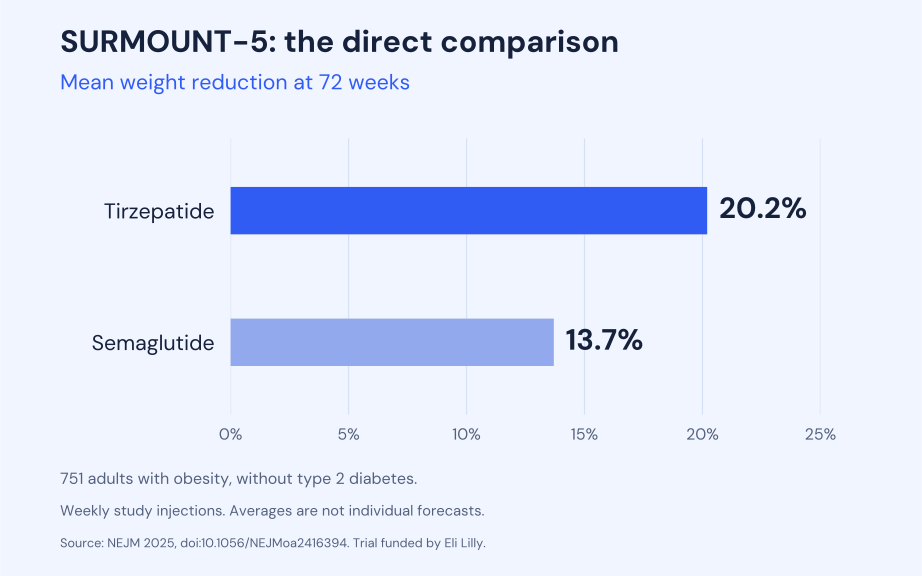
A person may reasonably ask how daily liraglutide compares with weekly medicines. These SCALE studies do not supply a direct randomized comparison with every current semaglutide or tirzepatide regimen. Comparing unrelated averages can mix differences in participants, duration, support and missing-data methods with differences between medicines. The fair question for a clinician is which evidence applies to the actual alternatives available to you. The fair question for a service is what that chosen treatment will cost and how care will continue. Neither question is answered by arranging a few study percentages from largest to smallest and labeling the biggest one the universal winner.
Bring the treatment and access questions together
A useful consultation separates expected benefit, tolerability, daily routine and the reason for choosing a specific product. A useful provider quote then names that same product and includes the ongoing cost of medicine, care and any required commitment. If one of those elements changes, reassess the whole arrangement rather than carrying an old expectation into a new prescription. For someone who values a daily routine, liraglutide may raise a different practical discussion from a weekly injection; that preference still sits within a clinical decision. The strongest use of SCALE is to make that conversation more precise, including what the evidence leaves unresolved about continuation and individual response.
If you are comparing support services, see our Henry Meds review.
For a related study question, read Semaglutide versus liraglutide: the STEP 8 comparison.
Sources
Research describes groups and specific study conditions. Your medical history, symptoms and treatment decisions require advice from your own qualified clinician.