In this article
What to know
- PIONEER 3 tested oral semaglutide against sitagliptin in diabetes. Dose, administration and treatment discontinuation matter to its interpretation.
- The studied population, comparator and follow-up determine how far the result travels.
- Use the findings to frame a discussion, rather than predict an individual result.
An oral comparison rather than an injection shortcut
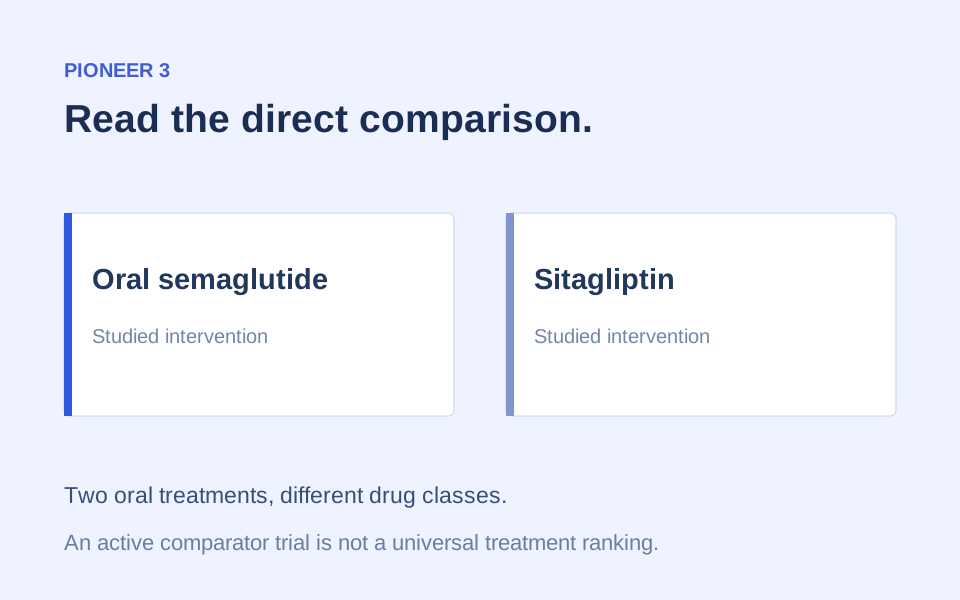
PIONEER 3 gives direct randomized evidence about oral semaglutide versus sitagliptin in adults with type 2 diabetes inadequately controlled on metformin, with or without a sulfonylurea. The useful finding is that the studied 7 mg and 14 mg semaglutide doses produced greater average HbA1c reductions at 26 weeks. The 3 mg group did not demonstrate noninferiority. That dose-dependent pattern is more informative than a blanket claim that a tablet form of semaglutide beats another diabetes pill. It also tells us nothing directly about an unapproved compounded dissolving preparation, which was not the product administered in this trial.[1]
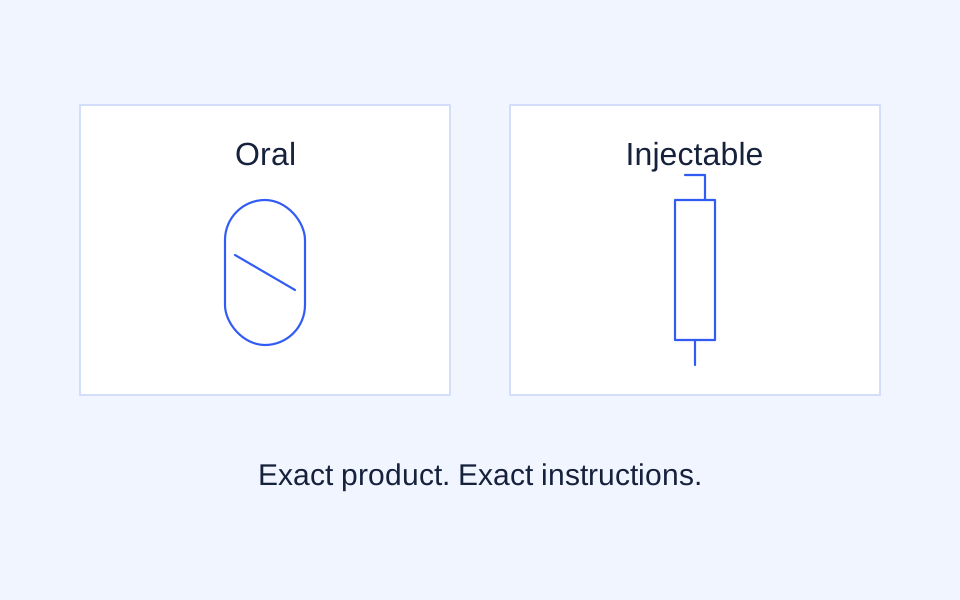
For the connected question, read our oral and injectable formulation guide.
The design improves comparability
Investigators randomized 1,864 adults in a double-blind, double-dummy trial lasting 78 weeks. The four assigned groups received daily oral semaglutide at 3, 7 or 14 mg, or sitagliptin 100 mg. Double dummy means participants received matching treatments so the different medicines could be compared while preserving blinding. That reduces expectation-related differences relative to an open-label study. It does not eliminate discontinuation, rescue treatment or uncertainty about missing measurements. Those practical complications are especially important when a medication has administration requirements and tolerability issues. The study's design is strong, while the details of how outcomes were analyzed remain essential to interpreting it.[1]
Twenty-six weeks was the primary comparison
Although follow-up extended to 78 weeks, the primary HbA1c comparison was at week 26. A reader should not attach the longer duration to a primary result measured earlier. The weight outcome at 26 weeks also favored the 7 mg and 14 mg semaglutide groups over sitagliptin, by estimated between-group differences of 1.6 kg and 2.5 kg respectively under the treatment-policy analysis. These are differences from an active diabetes medicine, not total expected weight loss and not evidence of an obesity indication. Timepoint and comparator are part of each number. Keeping them visible prevents a more impressive but inaccurate retelling.[1]
Why sitagliptin is a meaningful comparator
Sitagliptin is an oral DPP-4 inhibitor, so the trial addressed a plausible oral treatment decision in diabetes rather than comparing a pill with an injection simply because both are popular. The manuscript notes that DPP-4 inhibitors have relatively modest glucose effects and little effect on weight compared with GLP-1 receptor agonists. That context helps explain the comparison without making sitagliptin useless. A clinician may weigh tolerability, clinical circumstances, other drugs and treatment burden alongside glucose lowering. An active-comparator advantage is not evidence that every person taking the comparator should change treatment. It identifies a difference to discuss within an individualized care plan.[1]
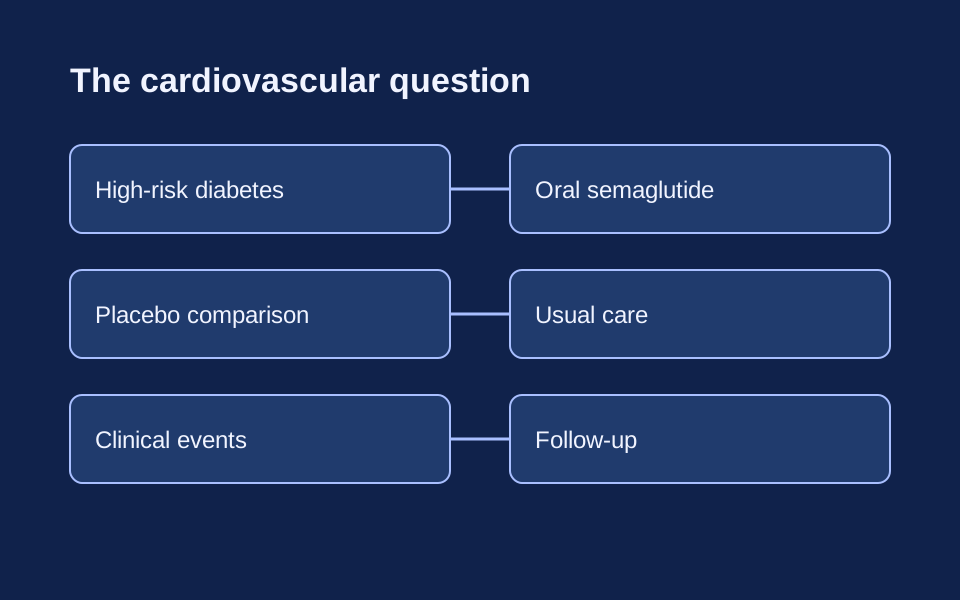
For the connected question, read the separate SOUL outcome trial.
The estimand changes what the average represents
PIONEER 3 reported both treatment-policy and trial-product estimands. In ordinary language, one analysis aims to reflect the assigned treatment strategy even when people discontinue or need rescue medication, while another focuses on the effect under continued trial treatment without rescue. Neither should be casually labeled the single real-world result. They answer related but different questions and require assumptions when data are missing. If a promotional summary chooses the larger effect without explaining the analysis, a reader loses useful context. The practical question is whether the quoted number describes assignment to a strategy or continued use under the trial's conditions.[1]
Discontinuation is not the same as study dropout
A participant can stop taking the randomized medication and still return for measurements. Conversely, remaining on treatment does not guarantee a complete data record. PIONEER 3 reported high trial completion alongside meaningful premature treatment discontinuation. That is not a contradiction. It is one reason the two estimands were helpful. For consumers, it means a study average should not be read as evidence that every participant could comfortably continue the medicine for the full period. A service assessment should separately ask what support exists if side effects, administration difficulties or other circumstances make the original treatment plan unsuitable.[1]
What flexible dosing adds
PIONEER 7 separately compared a flexible oral semaglutide strategy with sitagliptin over 52 weeks. Its approach allowed dose adjustment rather than assigning every semaglutide participant to a fixed maintenance dose from the outset. The result supports studying a treatment strategy as well as a fixed dose, but it does not make the two trials interchangeable. PIONEER 7 was open label, and its patient selection and protocol differed. Read it as complementary evidence about a clinically relevant approach. It does not allow a reader to choose their own adjustments or infer that a low dose will produce a higher-dose trial's outcome.[2]
For the connected question, read our Form Health assessment.
Formulation identity matters more in 2026
The FDA's 2026 labeling document covers Rybelsus tablets and Ozempic tablets with different tablet strengths. It explicitly warns that the products are not substitutable milligram for milligram. That makes it particularly important to identify the formulation behind an older paper. PIONEER 3's 3, 7 and 14 mg study groups refer to its studied oral formulation, not every present-day tablet bearing the same ingredient name. A compounded sublingual or dissolving product is also not validated by borrowing these numbers. Ask the prescriber and pharmacist to identify the exact approved product and instructions before assuming that matching an ingredient matches the evidence.[3]
Daily routine is part of the treatment discussion
Oral administration can sound automatically easier than an injection, but convenience depends on the person's routine and the product's instructions. The current FDA label specifies an empty-stomach administration process and a waiting interval before food, beverages or other oral medicines. The manuscript also acknowledges uncertainty about adherence outside the trial. This is not a reason to reject tablets; it is a reason to discuss the actual routine rather than judging convenience by needle avoidance alone. A formulation that fits one person's morning may be awkward for another. A clinician can assess that tradeoff alongside safety, response and other medicines.[1] [3]
The useful consumer conclusion
PIONEER 3 supports the comparative efficacy of the studied 7 mg and 14 mg oral semaglutide regimens against sitagliptin for a defined diabetes population. Novo Nordisk funded the research. The trial does not establish a medication subscription's quality, a guaranteed weight outcome or equivalence between approved tablets and unrelated preparations. Bring three questions to a consultation: which exact formulation is being considered, what outcome matters most, and how will tolerability and adherence be reviewed? Those questions preserve the study's value while making its limitations useful. A careful account of a tablet trial should make the product and the clinical decision clearer, not blur them.[1] [3]
For a separate look at ongoing care options, read our Ro and Form Health comparison.
Sources
Research describes groups and specific study conditions. Your medical history, symptoms and treatment decisions require advice from your own qualified clinician.