In this article
What to know
- Semaglutide 1.0 mg weekly outperformed liraglutide 1.2 mg daily on average HbA1c and weight over 30 weeks.
- The liraglutide comparator was below its maximum diabetes dose.
- This diabetes trial does not rank obesity-dose regimens or alternate formulations.
The answer belongs to two specific regimens
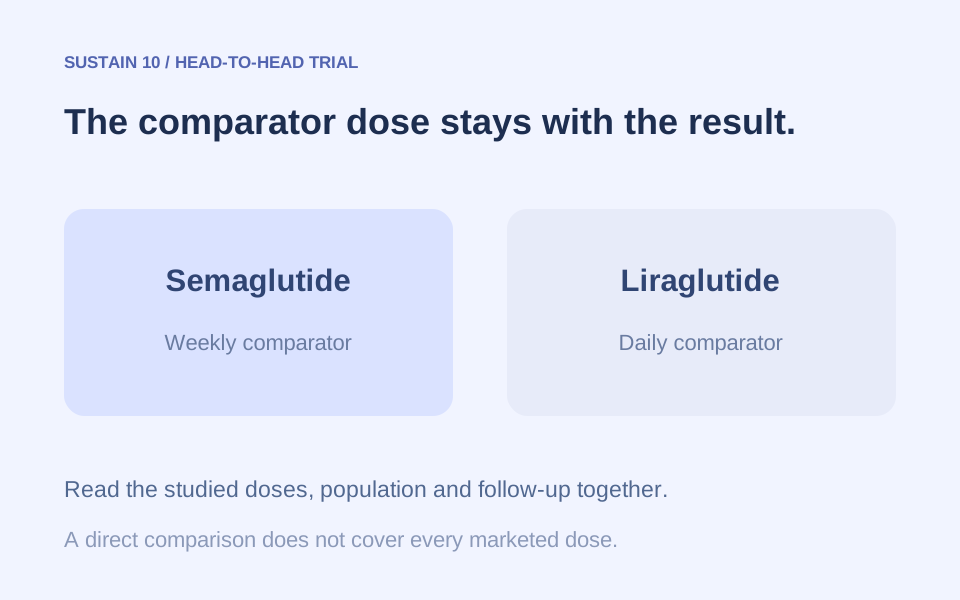
SUSTAIN 10 found larger average reductions in blood glucose and body weight with injected semaglutide than with injected liraglutide. The useful qualification arrives immediately: this was semaglutide 1.0 mg once weekly versus liraglutide 1.2 mg once daily in adults with type 2 diabetes. It was not a comparison of maximum doses, obesity indications or oral semaglutide. [1] A result can be convincing within its question while leaving a different buying or prescribing question unanswered. Before treating the trial as a general ranking, identify which prescription is actually being considered and which outcome matters most.
The weekly versus daily schedule is part of the tested treatment, too. A preference for fewer injections may matter to a person, but this trial cannot tell us that convenience alone caused the differences. Dose, molecule and schedule changed together. Separating them would require another design.
Who entered the trial
The open-label randomized study enrolled 577 adults with type 2 diabetes inadequately controlled on one to three oral diabetes medicines. Its principal comparison lasted 30 weeks. HbA1c, a measure of longer-term glycemic control, was the primary endpoint; body-weight change was a confirmatory secondary endpoint. Novo Nordisk sponsored the trial. [1] [2] These details establish a diabetes treatment-intensification question. They do not establish that the participants resembled someone without diabetes seeking their first obesity prescription.
Randomization improves the credibility of the comparison because treatment allocation does not simply follow patient or clinician preference. Open-label treatment still matters: participants and study staff knew which injection was used. Laboratory glucose measurements are less subjective than symptom reporting, but awareness can influence expectations, reported adverse events and persistence. Neither feature should be ignored or used to dismiss the whole study.
Read the glucose difference in percentage points
Average HbA1c fell by about 1.7 percentage points with semaglutide and 1.0 point with liraglutide. The estimated between-group difference was 0.69 percentage points in favor of semaglutide. [1] This is an additional reduction on the HbA1c scale. It is not a statement that blood glucose became 69% better, nor does the average establish where a particular person's HbA1c will finish.
The starting value and accompanying care affect how much room there is to improve. Someone close to their individualized target is asking a different question from someone substantially above it. The trial supports discussing comparative glucose lowering with a prescriber; it does not create a target or justify increasing a dose without reviewing tolerability, other medicines and the person's broader clinical needs.
Weight was important, but this was not an obesity-dose trial
Average body weight declined by approximately 5.8 kg with semaglutide and 1.9 kg with liraglutide. The estimated treatment difference was 3.83 kg over 30 weeks. [1] Kilograms here describe a change in body weight, not a measured loss of the same quantity of body fat. They are group averages from the diabetes population and treatment regimens in the study.
A direct comparison is stronger than placing unrelated studies in adjacent marketing columns. Yet directness does not erase scope. These figures cannot be substituted into a forecast for semaglutide 2.4 mg, liraglutide 3.0 mg, an oral preparation or a compounded product. Those are different treatment questions. A person choosing between obesity medicines should use evidence for those regimens rather than scaling this result upward in proportion to milligrams.
For the different obesity-dose question, read the STEP 8 obesity-dose comparison.
Why liraglutide 1.2 mg is the key limitation
The Victoza prescribing information includes 1.2 mg and permits an increase to 1.8 mg when additional glycemic control is needed. SUSTAIN 10 used the lower of those maintenance doses. [3] That does not make the comparator fictitious or the study invalid. It makes the conclusion specific. Semaglutide 1.0 mg outperformed liraglutide 1.2 mg under the trial conditions; the result does not quantify its advantage over liraglutide 1.8 mg.
Nor can we assume the higher liraglutide dose would eliminate the difference. That would be another unsupported leap. The honest interpretation leaves that comparison unresolved by this experiment. This distinction is especially important when an advertisement abbreviates the study to two drug names and drops the doses, population and follow-up that give the numbers meaning.
Tolerability belongs beside efficacy
Gastrointestinal adverse events were reported more often with semaglutide, and adverse-event discontinuation was also higher: 11.4% versus 6.6%. [1] A larger mean improvement therefore came with a persistence tradeoff. A treatment that looks favorable on an endpoint may still be harder for a particular person to continue. Discontinuation is a relevant outcome rather than an inconvenient footnote.
A later post hoc analysis of SUSTAIN 3, 7 and 10 examined whether nausea, vomiting and other gastrointestinal events explained the weight differences. It suggested that these events contributed little to semaglutide's comparative weight reduction. [4] This was a secondary analysis relying on modeling assumptions, not random assignment to nausea. It does not mean symptoms are necessary for benefit, harmless, or something to tolerate without clinical advice.
What 30 weeks cannot decide
SUSTAIN 10 was not designed to settle comparative heart attacks, kidney failure, long-term weight maintenance or outcomes after treatment stops. Its registered outcomes and main report address a shorter-term efficacy and safety comparison. [1] [2] A favorable HbA1c result should not silently become evidence of a particular cardiovascular benefit. Dedicated outcome studies answer different questions, with their own populations and time horizons.
The same restraint applies to cost. The study does not establish today's insurance coverage, availability, consultation fees or pharmacy total. A prescription can have a favorable trial result and an unaffordable access path. Keep clinical relevance and purchase terms visible together, without expecting either to substitute for the other.
For an access model centered on cardiometabolic care, see our 9amHealth diabetes-care review.
Bring the actual prescription to the discussion
The practical next step is to name the formulation, dose and indication when asking how this evidence applies. Then discuss the outcome being sought, the adverse effects that could interrupt treatment, and the plan for reviewing response. A headline about greater weight loss is less useful than a clear explanation of why a particular regimen fits the clinical problem.
SUSTAIN 10 supplies a meaningful direct diabetes comparison. Its limitation is equally meaningful: it does not compare every version of semaglutide with every version of liraglutide. Keeping that boundary intact makes the evidence more useful, because the reader can distinguish what the trial demonstrated from what the next treatment decision still requires.
Separate the trial from the purchase using our clinic versus pharmacy access comparison.
Sources
- SUSTAIN 10 randomized trial: semaglutide 1.0 mg versus liraglutide 1.2 mg (opens in a new tab)
- SUSTAIN 10 registered design and results, NCT03191396 (opens in a new tab)
- Victoza US prescribing information (opens in a new tab)
- Original post hoc analysis of gastrointestinal events in SUSTAIN 3, 7 and 10 (opens in a new tab)
Research describes groups and specific study conditions. Your medical history, symptoms and treatment decisions require advice from your own qualified clinician.