In this article
What to know
- The composite proportions were 9.9% versus 15.3%.
- Cardiovascular death alone did not show a demonstrated reduction.
- Companion analyses use the same randomized SUMMIT population.
The composite result needs its components
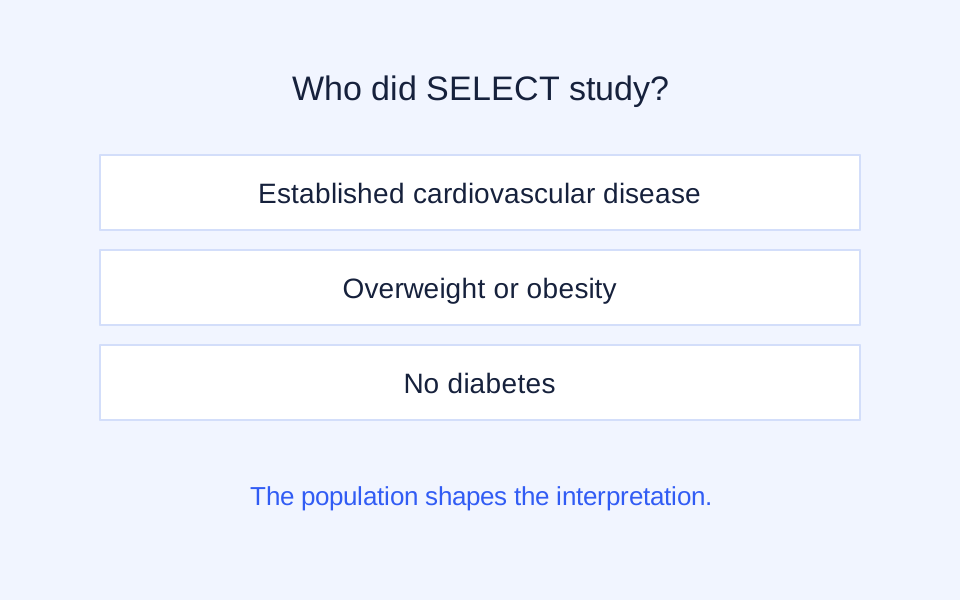
SUMMIT found fewer cardiovascular deaths or worsening heart-failure events with tirzepatide in adults with heart failure with preserved ejection fraction and obesity. [1] The combined result should not be shortened to a demonstrated reduction in cardiovascular death alone. Worsening heart failure and death are both important, but the evidence for each component differs. That is the first distinction to keep when a trial is summarized in a treatment advertisement. The study concerns established HFpEF with obesity, not a general claim that weight-loss treatment prevents heart failure in everyone. A useful explanation names the condition and endpoint before discussing a relative reduction.
The regimen was added to existing heart-failure care
The double-blind trial randomized 731 patients with an ejection fraction of at least 50% and BMI of at least 30 to weekly subcutaneous tirzepatide, up to 15 mg, or placebo. Median follow-up was 104 weeks. [1] The companion clinical report describes starting at 2.5 mg and increasing by 2.5 mg every four weeks as tolerated, alongside usual therapy. [2] That schedule explains the experiment; it is not a self-treatment instruction. The study did not test buying a prescription instead of maintaining cardiovascular care. Nor did it establish the same effect for a compounded preparation or a person with a different type of heart failure.
The observed composite difference was 5.4 percentage points
The composite occurred in 36 of 364 tirzepatide participants, 9.9%, and 56 of 367 placebo participants, 15.3%, with a hazard ratio of 0.62. Cardiovascular deaths alone numbered eight versus five, with a wide confidence interval. [1] The raw composite difference is 5.4 percentage points over the observed follow-up, not a thirty-eight-percentage-point reduction. The cardiovascular-death counts do not establish either a mortality benefit or a definite mortality harm. They are too uncertain for that simplified conclusion. Explain the favorable composite through its actual components, with the reduction in worsening heart-failure events kept distinct from an unsupported claim that fewer patients died of cardiovascular causes.
Symptoms and function add information without creating a new trial
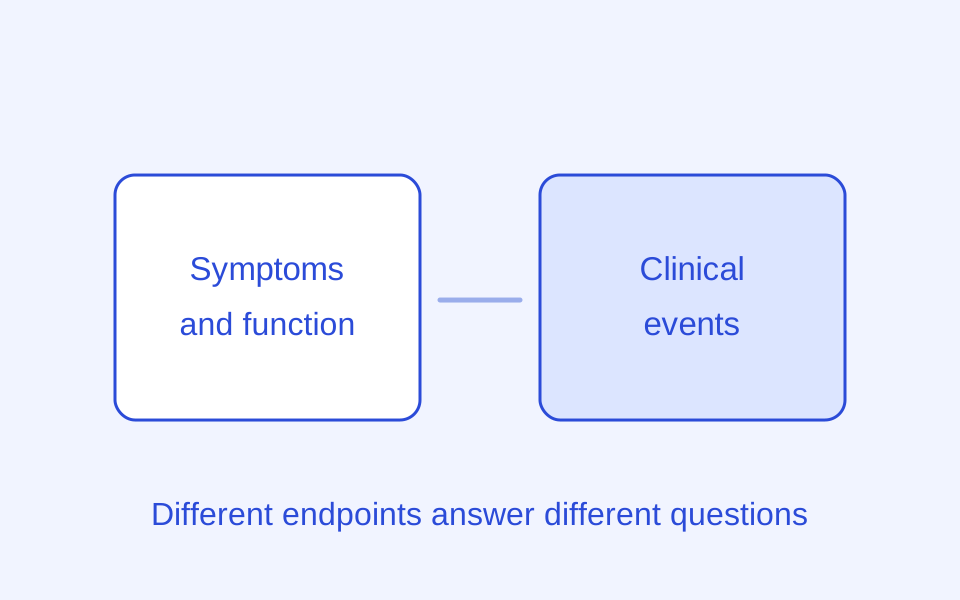
SUMMIT also assessed health status with the Kansas City Cardiomyopathy Questionnaire. At 52 weeks, the between-group improvement favored tirzepatide by 6.9 points. [1] The clinical-trajectory paper examines a broader set of symptoms, functional measures and definitions of worsening heart failure. [2] Those analyses deepen the same randomized experiment; they are not independent replication in another population. Their main functional assessments were at 24 and 52 weeks, and the authors note the need to study durability beyond a year. The longer event follow-up therefore should not be used to imply that every symptom and function measure was established over the same two-year horizon.
Mechanistic findings should not become a universal kidney claim
A secondary SUMMIT analysis examined blood pressure, estimated blood volume, inflammation and kidney-related measures. It reported lower systolic pressure and estimated blood volume with tirzepatide, while some laboratory results remained statistically uncertain at particular time points. [3] Those findings help investigate possible mechanisms; they do not prove that a single pathway caused every clinical benefit. Correlations between changes are especially different from a new randomized test of a mechanism. The same patients also had obesity-related HFpEF, so a favorable kidney-related measure cannot be promoted as proof of equivalent protection in every person seeking weight loss. Keep the population, measurement and analytical status together.
Tolerability is part of the same decision
Adverse events leading to treatment discontinuation, mainly gastrointestinal, occurred in 23 tirzepatide participants, 6.3%, versus five placebo participants, 1.4%. [1] That belongs beside the benefit rather than beneath it in tiny print. A treatment with a favorable trial result can still be unsuitable for a particular person or difficult to continue. The care arrangement should make it possible to discuss symptoms, other medicines and the effect on daily life. Someone comparing providers for a heart-failure-related decision needs more than a convenient refill route. They need a clinician who can place the proposed treatment within the wider management of that condition.
HFpEF evidence is not a ranking of all weight medicines
SUMMIT and trials of semaglutide in obesity-related HFpEF answer related but separate questions. Differences in populations, endpoints and follow-up prevent a simple ranking from headline percentages. A person should not infer that the medicine associated with the largest average weight change elsewhere must be best for their heart-failure situation. Nor should a price comparison quietly replace a clinical comparison. Start with the exact condition, goals and product under consideration. Then ask which trial is relevant and which questions remain unresolved. A service is more informative when it explains those boundaries than when it borrows several favorable results to create a broad cardiovascular promise.
For a related but separate trial program, read semaglutide HFpEF evidence.
The practical question is coordinated continuing care
SUMMIT gives clinicians and patients a stronger basis to discuss tirzepatide in the specific setting of HFpEF and obesity. It does not make the decision automatic or remove affordability and tolerability from the conversation. Ask which benefit matters most, how progress will be assessed and who coordinates changes with the existing heart-failure team. A general online weight-care subscription may or may not provide the relationship needed. Compare the actual clinical contact and responsibilities before the checkout price. The evidence is most useful when it leads to a clear, individualized plan, with a favorable composite described accurately and uncertainty about mortality or durability left visible.
For a continuing clinical-care model, compare our Form Health review.
Sources
Research describes groups and specific study conditions. Your medical history, symptoms and treatment decisions require advice from your own qualified clinician.